
Food Security
Admissions Open
Food Security Starts With Skills.
Agricultural Engineering at MMTVC develops practical skills for modern agriculture, agripreneurship, dairy production, extension and sustainable rural development — contributing to Kenya’s food-security agenda through skilled graduates.
Head of Department
Building and Civil Engineering
National Context
Be Part of Kenya’s Food Security Journey.
Food security, innovation, agripreneurship, sustainability and rural development sit at the centre of Agricultural Engineering at MMTVC. Training prepares learners to support productive farms, stronger food systems and enterprise pathways aligned with Kenya’s broad food-security agenda — without inventing programmes, partnerships or statistics.
-
Food Security
Skills that support reliable food production and agricultural services.
-
Innovation
Modern approaches to farming, enterprise and agricultural problem-solving.
-
Agripreneurship
Enterprise mindsets for farm business, services and value addition.
-
Sustainability
Practices that protect land, water and rural livelihoods for the long term.
-
Rural Development
Extension and community pathways that strengthen rural agricultural systems.
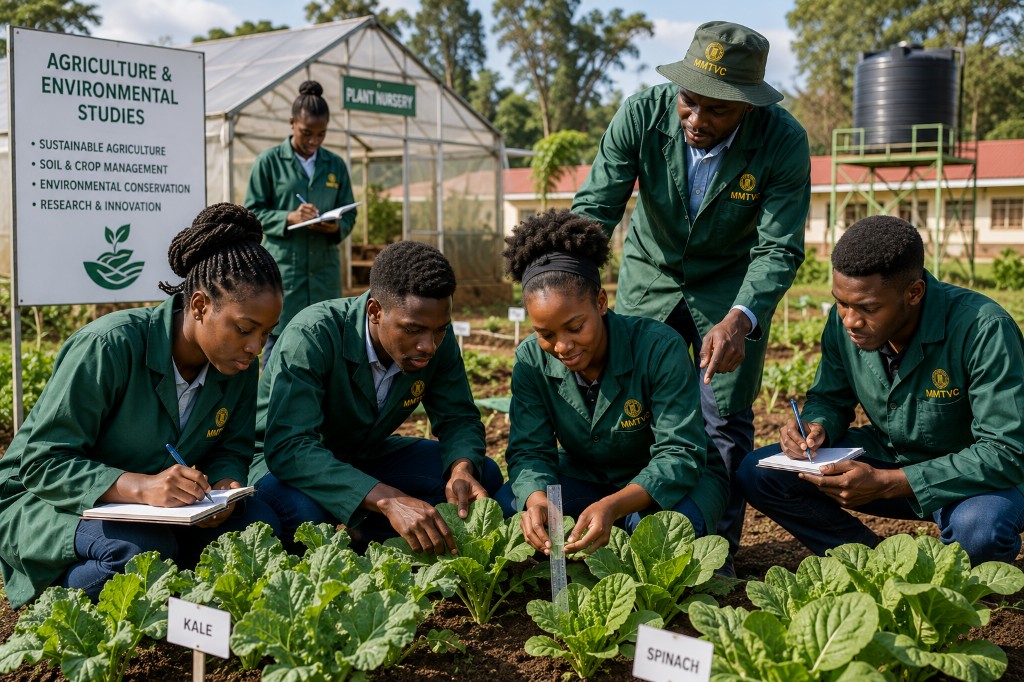
“Agriculture is the most healthful, most useful and most noble employment of man.”
Our Programmes
Five Agricultural Engineering programmes across Levels 4–6. Career pathways are illustrative and are not employment guarantees.
-
Agripreneurship
Entry- Level 4 KCSE D- or E.
- Level 5 KCSE D+, D Plain or relevant Level 4 qualification.
- Level 6 KCSE C- or relevant Level 5 qualification.
Apply NowCareer pathways are illustrative and are not employment guarantees.
- Agribusiness
- Farm enterprise
- Agricultural services
- Value addition
- Agricultural entrepreneurship
- Further education
-
Agricultural Extension
Entry- Level 5 KCSE D+, D Plain or relevant Level 4 qualification.
- Level 6 KCSE C- or relevant Level 5 qualification.
Apply NowCareer pathways are illustrative and are not employment guarantees.
- Agricultural extension pathways
- Community agricultural support
- Farmer training
- Agricultural information services
- Rural development support
- Further education
-
General Agriculture
EntryKCSE D- or E.
Apply NowCareer pathways are illustrative and are not employment guarantees.
- Farm operations
- Crop production
- Livestock production
- Agricultural enterprise
- Agricultural support services
- Further training
-
Dairy Farm Attendance
EntryKCSE D- or E.
Apply NowCareer pathways are illustrative and are not employment guarantees.
- Dairy farm operations
- Livestock production
- Dairy enterprise
- Farm support
- Agricultural entrepreneurship
-
Sustainable Agriculture for Rural Development
EntryKCSE D+, D Plain or relevant Level 4 qualification.
Apply NowCareer pathways are illustrative and are not employment guarantees.
- Sustainable agriculture
- Rural development support
- Community agricultural projects
- Agricultural enterprise
- Extension-related pathways
- Further education
National competence certification
Examined for competence
Except for professional courses and NITA pathways, all other programmes are examined by TVET CDACC — the TVET Curriculum Development, Assessment and Certification Council.
- College programmes TVET CDACC
- Professional courses Their examining bodies
- NITA pathways NITA
Agripreneurship
Don’t Just Grow Crops. Grow Value.
Agripreneurship Levels 4, 5 and 6 develop enterprise skills for agribusiness, farm enterprise, agricultural services and value addition — helping learners think beyond production alone.
Apply for Agripreneurship“The discovery of agriculture was the first big step toward a civilized life.”
Dairy Farm Attendance — Level 4
Dairy Skills for Productive Farms.
Dairy Farm Attendance Level 4 builds practical competence for dairy farm operations, livestock production support and dairy enterprise pathways.
Apply Now
Sustainable Agriculture
Grow Today. Protect Tomorrow.
Sustainable Agriculture for Rural Development Level 5 focuses on sustainable farming approaches, rural development support and community agricultural projects that strengthen livelihoods over time.
Apply NowModern Agriculture
Agriculture Is Changing.
From Farm Skills to Food Systems. Agricultural Engineering connects practical farm competence with broader food-system thinking — production, services, extension and enterprise.
“It's clear that agriculture, done right, is the best means the world has today to simultaneously tackle food security, poverty and environmental degradation.”
Your Pathway to Success
- Level 4
- Level 5
- Level 6
- Bachelor's Degree
- Further specialization
After completing an appropriate Level 6 qualification, a graduate may apply for admission to a Bachelor's Degree programme at an accredited university, subject to the university's admission requirements and recognition of the qualification.
Intakes
Grow Your Knowledge Base
From field practice to digital farm wisdom.
Agricultural Engineering learners can extend classroom and field learning through the E-Library — resources that support agripreneurship, extension, dairy and sustainable agriculture study.
- Study anytime with digital access
- Support coursework and revision
- Explore department-relevant materials
Learn beyond the field
Grow Knowledge with World Bank Group Academy
We encourage the Agricultural Engineering community to explore free courses on the World Bank Group Academy. Discover learning on agriculture and healthy, sustainable, inclusive food systems — key to achieving global development goals — and supplement your MMTVC training at your own pace.
World Bank Group Academy is an external platform operated by the World Bank Group. Course availability may change. Completing Academy courses does not replace MMTVC admission, assessment or certification requirements.
Need clarity?
Department FAQs
Quick answers for applicants exploring this department. For more topics, visit the College FAQs page.
Use Apply Now to open the existing MMTVC Application page, then select your preferred programme and intake.
Open View Fee Structure on this page or visit the College Fee Structure page for current fee information.
MMTVC typically offers January, May and September intakes. Use the intake links on this page for more information.
Open the E-Library page from the button in this section for digital library access guidance, platform links and support information.
No. They are external, self-paced resources we encourage the Agricultural Engineering community to explore alongside MMTVC training — including learning on healthy, sustainable and inclusive food systems. Completing Academy courses does not replace MMTVC admission, assessment or certification requirements.
Except for professional courses and NITA pathways, all other programmes are examined by TVET CDACC (TVET Curriculum Development, Assessment and Certification Council).
Ready to Grow Your Future?
Apply online, select an Agricultural Engineering programme and intake, then begin your journey at MMTVC.